I am relaunching this blog over on WordPress. I want to post more regularly and have thought long and hard about what type of content I could produce on a more consistent basis.
The new Windsor Kitchen will focus on cooking and recipes as well as food and restaurant news. I am hoping to adopt a less structured approach than I attempted here, making the post creation process more natural for me.
Please visit WindsorKitchen.wordpress.com for the next phase of posts and thanks for reading.
Monday, November 3, 2014

Monday, April 28, 2014
The Sunday: Homemade Gnocchi

I find myself continually coming back to this blog and apologizing (to myself really!) for not posting more frequently. However, in thinking about my food over the past few weeks, I haven't really made or eaten anything too exciting. Actually, the continued freeze of winter has driven me more toward alcohol in the past month (my next post will cover wine tasting). A couple of weeks back I made gnocchi from scratch, and the result was a hearty, traditional weekend meal that was fun to make and even more fun to eat.
A while back I made ravioli, an attempt that was new for me because raviolis were not made in my house, they were bought. Gnocchi on the other-hand are not ravioli; gnocchi was made and rolled one by one. My grandmother used to make the dough, then chaos would ensue. My gnocchi were rolled thick and cut large whereas my sister's were rolled thin and cut small. In our competition for whose were better, we all but assured that nothing would cook evenly if put into the same pot! Even today, my sister and I still stand firm on which type are better to this day.
Paired with fresh tomato sauce, you'll have the best Sunday meal and enjoy the process of making it. The recipe is simple and the method to make them even simpler. You can perfect your recipe to your liking, but the one below has been improved and tweaked for decades. If your nervous about the process, check out this nice video from Saveur magazine on making a classic Gnocchi al Pomodoro:
Recipe
· 6 large potatoes
· 1 teaspoon salt
· 1/8 cup oil (as needed)
· 1 egg
· 2 1/2 cups flour (semolina or white)
1 Boil the potatoes, with skin on, in water until tender. Drain, peel, and mash before cooling in refrigerator for an hour.
2 Either by hand or in a mixer with a dough hook, mix the potatoes, salt, egg, and flour thoroughly. If the mixture begins to look dry, add oil (up to 1/8 cup).
3 Break off piece of dough to match size of your palm. Roll dough into a rope and cut gnocchi into 1/2" pieces. For design purposes, with your thumb, roll gnocchi off back of fork to get ridges. Set aside on a floured baking sheet.2 Either by hand or in a mixer with a dough hook, mix the potatoes, salt, egg, and flour thoroughly. If the mixture begins to look dry, add oil (up to 1/8 cup).
4 Boil your gnocchi and take out when they float to top of pot. Pair with sauce and serve.
Tuesday, March 11, 2014
The Dish: Beef Stew with Mashed Turnips

Remember my resolution to post more regularly? Well that seems to have not made it out of January! It is 60 degrees here in New York City today, so you might think who wants a stew recipe right? This winter might never end because Thursday we are bracing for more snow and some stew might just hit the spot. Enjoy!
Recipe
· 1 batch of Mashed Turnips
·
· 2 tablespoons olive oil
· 1.5 lbs. trimmed beef stew meat
· 1 tbsp. sea salt & black pepper
· 3/4 cup chopped yellow onion
· 3 cloves chopped garlic
· 2 tablespoons all-purpose flour
· Half- bottle dry red wine
· 2 cups vegetable stock
· 12 small cipollini onions, peeled
· 12 baby portabello mushrooms, chopped
· 12 baby carrots, peeled
· 1 tsp. sugar
· Fresh parsley
NOTE: This beef stew recipe is a take on the Pioneer Woman's Sunday Night Stew and Food & Wine's Beef Stew In Red Wine Sauce recipes.
 1 Make the mashed turnips ahead of time and set aside. Reheat before
serving.
1 Make the mashed turnips ahead of time and set aside. Reheat before
serving.
2 Preheat oven to 350 degrees.
3 In an uncovered Dutch oven/casserole pot, melt butter in 1
tablespoon of olive oil then add beef in a single layer and season with salt
and pepper. Cook over medium-high heat, turning occasionally, until browned on
all sides.
 4 Add chopped yellow onion and garlic and cook for 5 minutes. Add flour and stir to coat the meat with it. Add wine, vegetable stock, and season
with salt and pepper. Bring to a boil.
4 Add chopped yellow onion and garlic and cook for 5 minutes. Add flour and stir to coat the meat with it. Add wine, vegetable stock, and season
with salt and pepper. Bring to a boil.
5 Cover pot and transfer to oven. Cook for 1 1/2 hours, until the
meat is very tender.
 6 In a large skillet, combine pancetta, cippolini onions,
mushrooms and carrots. Add the remaining 1 tablespoon of olive oil, 1/4 cup of
water, 1 teaspoon of sugar, and season with salt and pepper. Bring to boil,
cover, and simmer for 10 to 15 minutes until the liquid reduces.
6 In a large skillet, combine pancetta, cippolini onions,
mushrooms and carrots. Add the remaining 1 tablespoon of olive oil, 1/4 cup of
water, 1 teaspoon of sugar, and season with salt and pepper. Bring to boil,
cover, and simmer for 10 to 15 minutes until the liquid reduces.
7 Uncover and cook over high heat, tossing, for 5 minutes.
8 Scoop mashed turnips into plate, place with vegetables
and pancetta on the side, and then top vegetables with stew. Garnish with chopped fresh parsley, serve.
Wednesday, February 12, 2014
The Technique: Stewing
It has been cold here in New York City over the past month. Every few days ice and snow pelt the Tri-state area as temperatures rarely reach freezing. Now is the perfect time (especially with a storm coming overnight) to make a large pot of stew that will warm you up and provide you with meals for the next few days. My mother made a vegetable and potato stew in a tomato based broth growing up that, just thinking about it, makes me think of cold winter nights.
Stewing is one of the simplest ways to prepare food as well as one of the oldest. In its simplest definition, a stew is simple a collection of vegetables and/or meat cooking in a pot with a liquid and served with the sauce it was prepared in. People have been making stews since ancient times. Before the advent of pots which could withstand high temperatures, people would make stews by boiling ingredients inside the stomachs of animals.
In every culture, there is a recipe for some thing resembling a stew. Meat based stews are started by browning the meat, often using tougher cuts which soften as they cook, before adding stock or wine and letting the ingredients simmer until the liquid reduces. One of my favorite recipes to start from is the Pioneer Woman's Sunday Night Stew which is a great example of a beef stew recipe. In my next post, I will put my own spin on beef stew.
Thursday, January 23, 2014
The Cut: Pancetta
Pancetta is to Italians what bacon is to Americans. If you speak to most of us Americans, you know that pancetta must be pretty much the greatest thing ever invented over there! Made of pork belly that is salt cured and spiced with black pepper, pancetta is used in one way or another throughout all of Italy. I particularly like to use pancetta with eggs for breakfast or with sauteed vegetables to give another dimension of flavor. Eataly here in New York also has a great pancetta panini, which features thin slices of pancetta topped with vinegar-marinated vegetables.
 |
| Retrieved from http://www.fossilfarms.com/images/pic-diagram-bellota-pork.jpg |

Most of the time when cooking with pancetta I go to the local deli counter and ask for it unsliced. Once I begin cooking, I cut the pork into tiny pieces and brown in a pan before adding eggs or onion or Brussels sprouts or red wine. While pancetta costs more than bacon, it certainly gives you more flexibility in the kitchen and allows you to experiment more than using smokey thick cut bacon which forces its flavor on most foods.
Friday, January 17, 2014
The Review: Consider the Fork
 |
| Retrieved from http://www.considerthefork.com/ |

My cousin gave me this book for Christmas and I have been reading it on my commute for the past several weeks. I really enjoy it, although I can see how it is not a book for everyone. Consider the Fork is an amazingly in-depth history of the evolution of domestic cooking. From 15,000 B.C. to today, Bee Wilson provides the reader with intriguing facts and stories about how some of the most common technologies (pots, knives, cutlery, and more) in our kitchens have evolved over time. How much carbon is in a stainless steel knife? 0.75% is optimal. Why is the spork so great? It's not, for many reasons. Ever wonder about the importance of cooking pots? They allowed previously inedible foods to be cooked in water. It is that type of information that makes Consider the Fork such a dense encyclopedia of cooking facts. I love to learn about food and cooking, so this book was perfect for me, but I can certainly understand how the percentage of carbon in your 6" Santoku knife isn't everyone's cup of tea!
- Jump around from chapter to chapter and read about what you're interested in
- Expect dense chapters that go into great historical detail
Paperback Edition from Barnes & Noble
From the New York Times:
"Only when you find yourself rattling off statistics at the dinner table will you realize how much information you’ve effortlessly absorbed."
"Wilson’s insouciant scholarship and companionable voice convince you she would be great fun to spend time with in the kitchen."
Wednesday, January 15, 2014
The Recipe: Mashed Turnips
She loves turnips and growing up she ate them on Thanksgiving, Christmas, and with a roast beef. Once I tried them, I loved turnips too. Their flavor is unique, somewhere between a radish and a potato, and they are healthier than potatoes by a long shot - 35 calories for one of average size. Now I love potatoes, I really do, but the taste of turnips really brings an extra dimension to any dish which is why I love this recipe for mashed turnips. The potatoes bring starchiness and the turnips bring flavor.
 |
| Retrieved from http://cdn.blogs.sheknows.com/gardening.sheknows.com/2011/01/turnips.jpg |

Turnips are a root vegetable which has been consumed by humans for thousands of years. As Wikipedia so sagely describes, Pliny the Elder considered the turnip one of the most important vegetables of his day. In Hellenistic and Roman times, turnips were used to feed livestock as well as people.
The turnip is now enjoyed by people all over the world, mostly in the autumn and winter months. It is incredibly nutritious and a healthy alternative to the potato. In addition, the leaves can also be used. Turnips can be roasted and baked, traditionally those are the most popular methods of cooking here in the US, but I truly love this recipe for mashed turnips.
Recipe
· 3 white turnips
· 2 Yukon gold potatoes
· 2
· 1 cup shallot, red onion, and spring onion (¼, ¼, ½)
· 1
· 1 tablespoon salted butter
· ¼ cup whole milk
NOTE: This mashed turnips recipe is an amalgamation of numerous recipes I have prepared over the years.The primary inspirations are: Food & Wine's and Bon Appetit's recipes. I prefer more onion flavor than most recipes, and the recipe below reflects that preference.

1 Dice garlic, shallots, red onion, and spring onion. Set aside.
2 Peel turnips and potatoes then cut into 1" and 1/2" cubes respectively. Add to large pot of boiling water and cook until tender, about 10 minutes. Drain.
4 Season with salt and pepper to taste. Serve.
Monday, January 6, 2014
The New Year: A Healthy Start

Happy New Year! A crazy end to 2013 left me unable to add new posts, but one of my resolutions for 2014 is to add content to this blog more regularly.
Blog writing is not exactly a widely shared New Year's resolution, but eating more healthy/dieting is always at the top year-on-year. I have seen a lot of different articles over the past month which outline the best ways to start off 2014 from an eating perspective, and my favorite concept is also one of the simplest.
Mark Bittman's New York Times column last week discussed many sustainable food resolutions, but I especially liked the one which involved making the foundation of your weekly meals on Sunday. I believe it is a great way to enforce healthy food habits throughout the hectic work week. I have decided to adopt this resolution myself for the coming year.
 I will be cooking vegetables, leafy greens, beans, and grains on Sundays to use throughout the week in soups, salads, or healthy "bento box" lunches. This will not only save me money throughout the week, but also help me avoid making bad food choices at the office.
 Read the relevant excerpts from Mark Bittman's column below:
"Cook simple, unseasoned vegetables every few days. You can steam or parboil or microwave. Once cooked, vegetables keep a long time. And then they’re sitting there waiting to top pastas and grains, to bolster soups and salads, to whip up veggie wraps or just to reheat in oil or butter with seasonings."
"Cook big batches of grains and beans. Because it’s nearly effortless, and having cooked grains and beans on hand at all times makes day-to-day cooking a breeze. They will keep in the fridge up to a week."
If you too want to adopt this as a resolution in 2014, try out some of the recipes below:
Beans
Greens
Grains
Vegetables
Friday, October 18, 2013
The Dish: Zucchini Involtini

Simple. Fresh. Italian. Each of those words describe every meal my wife and I ate while traveling the Amalfi Coast on our honeymoon this summer. Another word was a constant as well, a word we did not expect. We noticed that no matter where we went - Ravello, Amalfi, or Positano - zucchini was everywhere. In pastas. On pizzas. Grilled. Fried. Amalfitans love their zucchini, and with good reason, it is amazing when fresh and in season. I translated my food experiences from that vacation into this dish - zucchini involtini.
This dish is perfect for a weeknight meal, a weekend splurge, or a dinner party with friends. There are three components which can all be done up to a day in advance before putting the involtini in the oven to cook before serving. Another reason why this is a perfect dish is because of the ingredients. Tomatoes, ricotta cheese, zucchini, lemon, and basil can be found pretty much year round in grocery stores. So while this dish is representative of my summer, I fully plan on making it this fall and winter as well.

 Next we move onto the cheese filling. Traditionally, one would think of mozzarella cheese right? And mozzarella would absolutely work here, but for the sake of my waistline I used part-skim ricotta cheese. Important note here, put the ricotta in a sieve over a bowl and lightly salt it, then leave it for a half hour. This will render a lot of the water out of the ricotta and avoid a soggy end product. Add the cheese to a mixing bowl after salting, and then combine with some fresh basil, Meyer lemon zest, olive oil, and black pepper.

Suggested Sides:
Tuesday, October 15, 2013
The Technique: Grilled Vegetables

Who doesn't love grilled vegetables? Fresh flavors combined with a smoky char, nothing better represents summer than grilled vegetables. As an apartment dweller in New York City, grilled vegetables are not restricted to the warm summer months. With a large grill pan, vegetables can be grilled year round, with zucchini and tomatoes being replaced by butternut squash and beets as the seasons turn. For me, the best technique is the simplest: fresh ingredients and a hot grill(pan).
Vegetables are unique, and no two vegetables cook exactly the same. If you try and grill eggplant along with tomatoes the same way for the same amount of time, you will be in trouble. A thick slice of tomato might take a few minutes to cook whereas a thick slice of eggplant might take up to 10 minutes! Martha Stewart's website has a fantastic guide for grilling all types of vegetables from eggplant to peppers to mushrooms. Remember that timing your vegetables is important. Peppers before zucchini. Eggplant before tomatoes. 
There are some steps home cooks can take to ensure that whatever vegetable you grill, you get the best flavors on your plate. First, use olive oil. I may have a Mediterranean cuisine bias here, but a really good olive oil goes a long way in drawing out flavor from your vegetables. Second, use fresh herbs. As with olive oil, fresh herbs go a long way toward bringing out flavors in your vegetables. Here is a a great guide from Epicurious for fresh herbs and some examples of recipes which showcase each herb. Finally, cut vegetables to same size pieces. This might seem obvious, but nothing is worse than a plate a vegetables where half are cooked into oblivion and the other half are still raw! By preparing them to the same size and cooking them for the appropriate amount of time, all of your veggies will be cooked to the same degree when you serve them.
There is no "best" way to prepare grilled vegetables, as different people have different preferences. There are, however, wrong ways to prepare grilled vegetables. Grilled vegetables should not be hard or soft, but tender just like a steak. By understanding the vegetables you are cooking, using olive oil and fresh herbs, and cooking veggies of the same size, you will be hard pressed to go far wrong!
Wednesday, October 2, 2013
The Cut: Meyer Lemon

Meyer Lemons. They are the smaller, orange-tinted, more expensive cousins of standard lemons. The reason for the color difference? A Meyer Lemon is thought to be a cross between a lemon and a mandarin orange. They were introduced to the United States only in 1908 by Frank Nicholas Meyer, an employee of the United States Department of Agriculture who collected a sample of the plant on a trip to China.1 Meyers were never commercially popular because of their thin skins, high juice content, and sweet flavor.

To learn more about the history of the Meyer Lemon, listen to an NPR interview on the fruit below:
1 http://www.npr.org/templates/story/story.php?storyId=100778147&ft=1&f=1053
Thursday, September 19, 2013
The Review: Gotham Greens
 |
| Retrieved from http://gothamgreens.com/our-farm/. |

Review
I knew nothing about Gotham Greens when I purchased a package of basil at my local grocery store. All I knew was that their basil looked so much better than the rest of the basil in stock. When I ate it at home I found out that it certainly was better, it was great. It looked fresh. It tasted fresh. It was fresh.
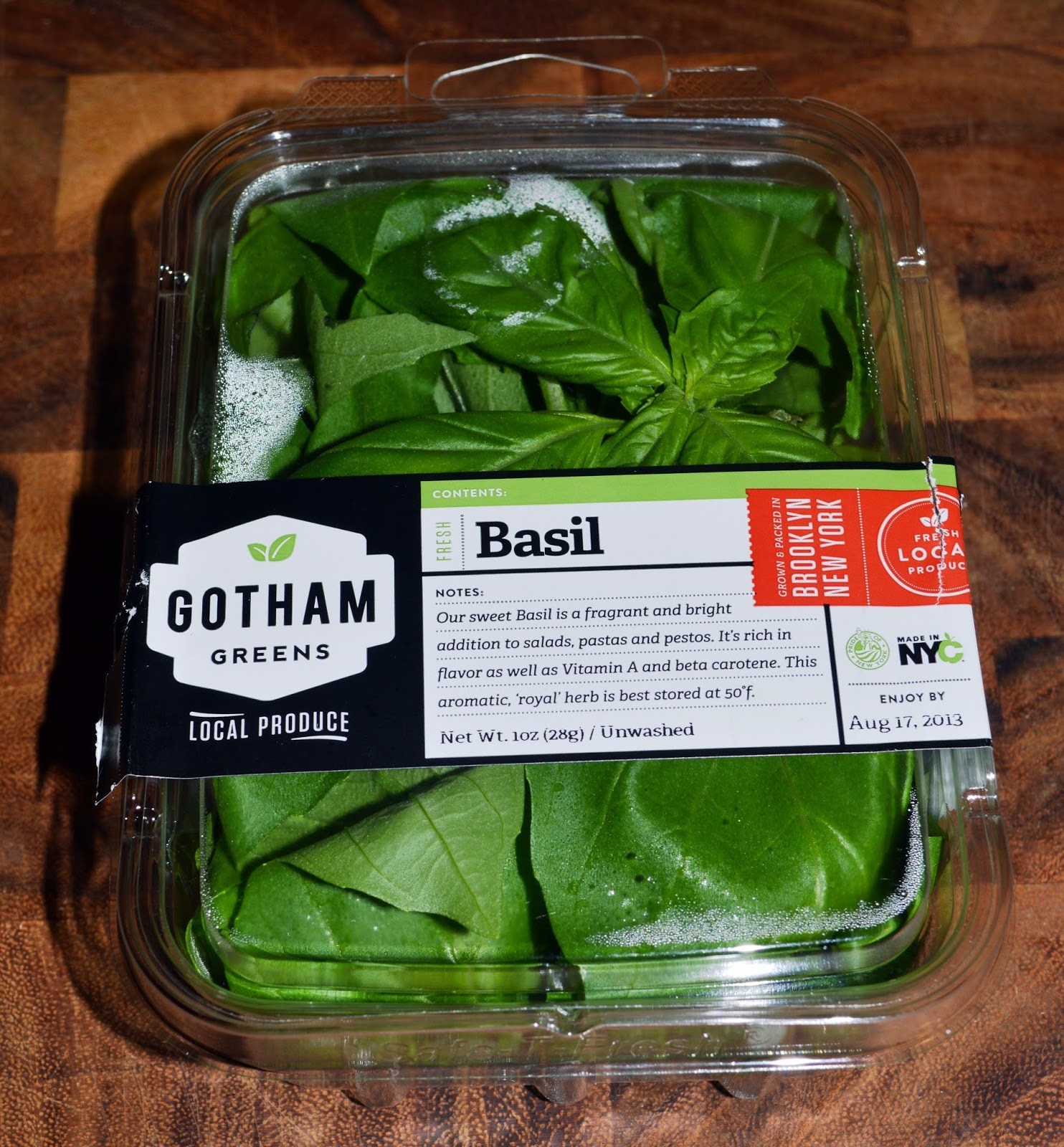
The company, founded in 2008 and harvesting since 2011, is planning on expanding what it plants beyond basil and lettuces. They need to expand their varieties because Gotham Greens has teamed up with Whole Foods to build a 20,000 square foot greenhouse on the roof of the new (yet to be built) Gowanus Whole Foods. The company will also become a supplier of produce for other Whole Foods stores throughout the city. Check out the video below to learn more about them:
Gotham Greens from Dark Rye on Vimeo.
Here is a complete list on where to buy Gotham Greens products. As of now their products can only be found in stores here in New York City, although visitors can try their produce at Gramercy Tavern, of which Gotham Greens is a supplier.
Subscribe to:
Posts (Atom)